
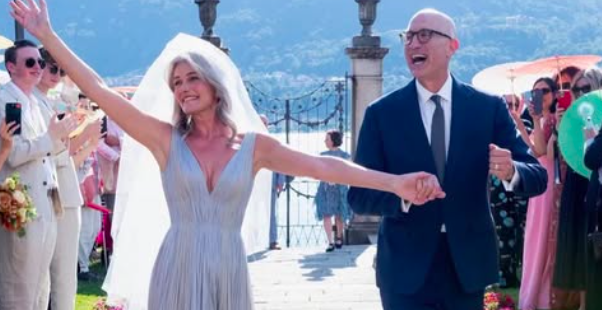
On July 3rd, supermodel Paulina Porizkova tied the knot with television writer Jeff Greenstein. The picturesque event took place on Lake Orta in Northern Italy, where an intimate gathering of just 78 guests watched Porizkova don her unconventional, plunging silver-grey wedding gown.
At 61 years old, Paulina Porizkova has spent the last few years building a public argument: aging, love, and desirability don’t belong to any one stage of a woman’s life — women should be able to explore them throughout. Porizkova demonstrated this philosophy in how she approached her second marriage.
An Intimate Scene
The legal ceremony took place in Florence in June; the celebration followed on July 3rd at Lake Orta in Northern Italy, with a reception at the nearby Villa Crespi. Porizkova shared beautiful images of the ceremony on her Instagram. Her wedding dress, which the House of Gilles Couture designed, showcased Porizkova’s unique aesthetic tastes. Mini horizontal pleats and a floor-length sheer skirt broke the conventions of the traditional bridal look. Porizkova told Vogue Magazine,
“I wanted the color to be sort of not a color. Something ineffable and elusive, so you couldn’t say ‘she wore a yellow dress’ or ‘she wore a pink dress.'”
Porizkova and Jeff Greenstein dated from 2023 before getting engaged in 2025. The couple frankly revealed the practical side of their decision to marry: Porizkova has said that marriage gives partners the legal standing to make medical decisions for one another — a detail that says as much about the realities of later-life love as any romantic quote could.
Paulina Porizkova on becoming the best version of herself
Porizkova told Vogue that the brief for her bridal look was simple: she wanted to look like her very best self. To get there, Porizkova chose natural methods over cosmetic ones, refocusing her gym routine and going all in before the wedding. By the time her preparation was over, she reported feeling much stronger:
“I lifted weights three times a week, adding in Pilates and aerobics so I was working out six days a week.”
Paulina Porizkova’s Aging Philosophy
For close to a decade, Porizkova has used her platform to push back against societal norms that treat older women poorly — especially the unspoken rule that a woman’s visible signs of aging need correcting.
Porizkova has never had cosmetic surgery, fillers, or Botox, and she describes her face as a lived-in record of her own life. While she admits to the occasional non-invasive treatment, she describes self-acceptance as an ongoing practice. One could argue that this honesty is what draws people to her perspective. Porizkova maintains that aging naturally isn’t an easy experience, but it’s definitely a worthwhile one.
Her wedding made these philosophies tangible: a woman in her later years choosing not to soften or minimize herself for the occasion, showing up exactly as she chooses to — silver hair, wrinkles, sheer fabric, and all.
Later-Life Marriages
Porizkova’s story also taps into something larger happening across the culture: more people are marrying, or remarrying, later in life than in previous generations.
Strikingly, according to the Pew Research Center, two-thirds of previously married adults ages 55 to 64 had remarried as of 2013, up from just over half in 1960. Half of previously married adults aged 65 and older had remarried, compared to about a third in 1960.
A phenomenon known as “gray divorce” — divorce among those 50 and older — has been climbing for decades. Bowling Green State University’s National Center for Family & Marriage Research found that divorce among those 65 and older nearly tripled between 1990 and 2022, meaning roughly one in ten people divorcing in the U.S. today is a senior.
Does this have something to do with the fact that people today are living longer than previous generations? The trend points to several overlapping factors: destigmatized divorce, greater financial independence for older women, dating apps reaching an older demographic, and — notably — rising life expectancy.
Susan Brown of Bowling Green State University, a leading researcher on gray divorce, suggests that longer lifespans may be part of what’s driving both the divorces and the remarriages. As people gain more access to information about their health, individuals in their 60s and beyond are recognizing that they may have decades of healthy life ahead of them — a realization that makes them less willing to spend those years in a relationship, or a single life that doesn’t fulfill them.
Living Longer, Loving Later
Paulina Porizkova’s wedding serves as a snapshot of two cultural shifts: her argument that women must refuse to let age dictate how visible, desirable, or outspoken they’re allowed to be, and the wedding itself, which demonstrates that older adults — thanks to longer, healthier lives — can now choose new partnerships rather than assuming their romantic lives are behind them.
While the longevity science industry can’t take direct credit for any individual marriage, the trend appears to be moving in the same positive direction. We shouldn’t compartmentalize our emotional lives once we reach a certain age — and if we embrace aging naturally, it will definitely be worthwhile.

![women [longevity live]](https://longevitylive.com/wp-content/uploads/2020/01/photo-of-women-walking-down-the-street-1116984-100x100.jpg)