
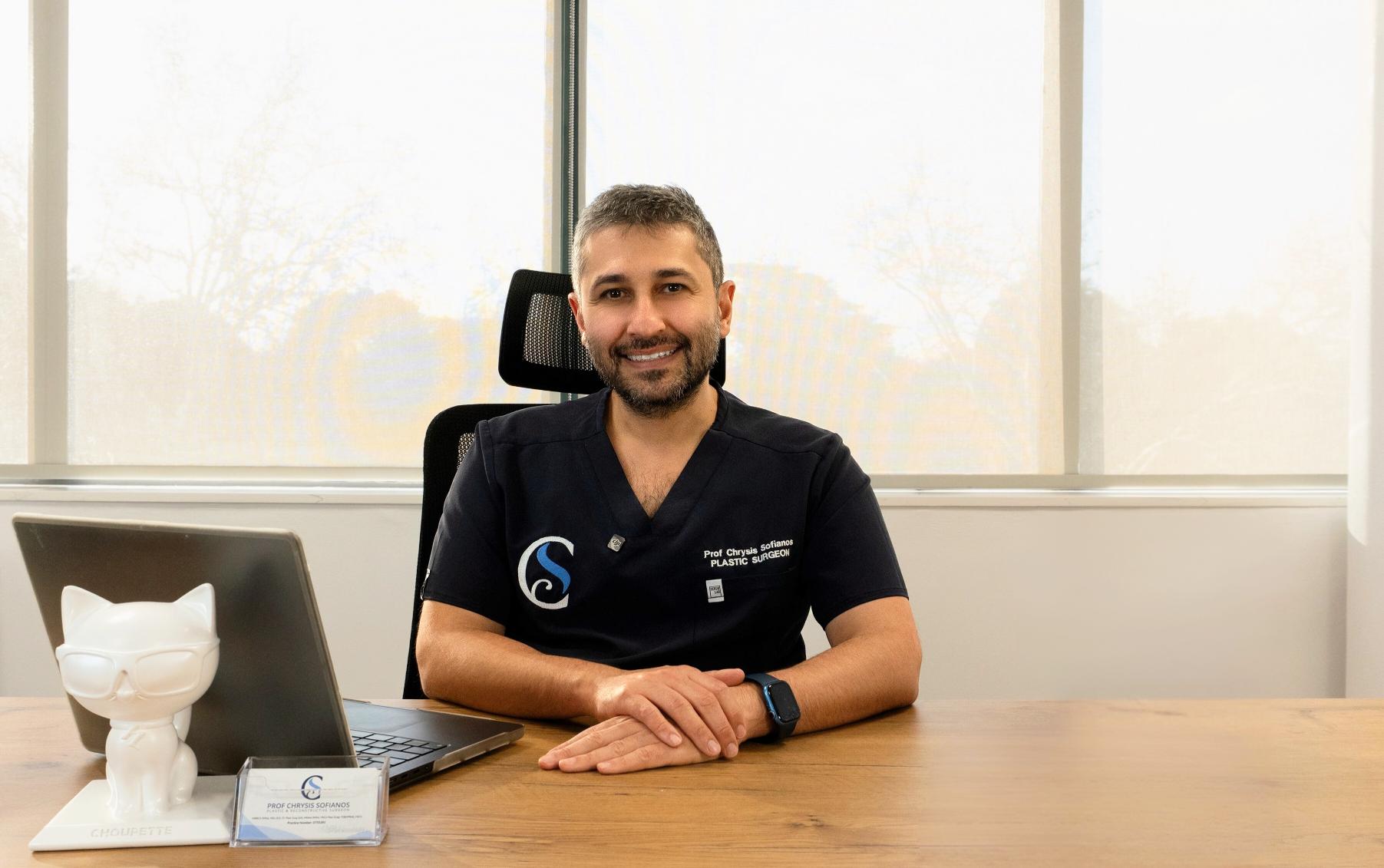
Professor Chrysis Sofianos is a triple board-certified plastic surgeon and academic head of the Division of Plastic and Reconstructive Surgery at the University of the Witwatersrand. He joined Gisele Wertheim Aymes, founder of World of Longevity, for a Wednesday Wellness discussion on a phenomenon he calls “maxxing culture.”
The growing online movement in which young men attempt to engineer their faces and bodies toward hyper-masculine ideals. Professor Chrysis Sofianos describes the risks of certain cosmetic procedures and trends he finds increasingly dangerous. These include cauliflower ear, jaw maxxing, leg-lengthening surgery, black-market injectables, and the post-pregnancy “mommy makeover.” A central concern is that social media is perpetuating a demand for these procedures. Furthermore, the demand is occurring faster than the medical industry can respond.
Sofianos On The Pursuit Of Cauliflower
Cauliflower ear is not a new thing. It started as an occupational hazard of boxers, wrestlers, and rugby players. It happens when a blow to the ear causes blood to pool between the skin and the cartilage. If left untreated, the body responds to that trapped blood with scarring and fibrosis, permanently distorting the ear’s shape. Shockingly, Sofianos reports that people are now purposefully pursuing this injury.
“It’s trying to be bigger and better and stronger and more manly, the cauliflower ear is an injury… it’s not a sign of masculinity, it’s not a sign of being tough. However, with TikTok, with social media trends, with the maxing culture, people are going out and doing this to make themselves seem more manly, make themselves seem more appealing.”
Once blood collects in that space, doctors need to drain it within roughly a week to reverse the damage. Unfortunately, leaving it for one to three weeks lets scarring set in. Over months, the scarring can calcify into a permanent irreversible thickening of the cartilage. The deformity rarely affects hearing, unless it’s severe enough to block the ear canal physically. But it permanently changes the ear’s appearance.
“Looksmaxing”: Sofianos on the Wider Ecosystem of Self-Modification
Cauliflower ear represents just one entry point into a much larger online subculture that is rapidly progressing towards mainstream media. Sofianos lists off maxxing trends he’s been tracking: jaw maxing, or aggressive attempts to widen or square the jawline; “looksmaxing” more broadly, optimizing every facial feature — eyes, jaw, symmetry — against an idealized template; anabolic steroid use; and at-home DIY filler injections. Leg-lengthening surgery is another, in which surgeons break the legs and slowly distract them apart to add several centimetres of height.
“I think the background to all of these is body dysmorphia and misunderstanding of what makes you seem attractive or what makes you seem masculine or feminine.”
Sofianos makes sure to distinguish these trends from the ordinary demand for cosmetic work. What concerns him is not the desire to look better. It is more so the emerging pattern of self-harm pretending to be self-improvement. Especially, when this pattern is appealing to minors who cannot legally consent to the procedures these adults are promoting online.
Sofianos has observed parents bringing children in for fillers, breast augmentation, or even rhinoplasty before the age of 18. He says his practice declines these requests outside of clear medical need. Alarmingly, some young people are sourcing injectable products directly online, bypassing medical supervision entirely.
“It comes to the culture that we’ve created, the fact that anything is fixable… has been normalized for children as well.”
Why Nobody’s Stepping In
The unfortunate truth is that the medical industry has been slow to meet this trend where it actually lives.
“I think we are failing in terms of it being a social media trend and quickly dismissing it, we need to reach those kids and those individuals on platforms that they more commonly visit… addressing it on Instagram, addressing it on TikTok, I think that’s probably the first point.”
One could compare it to cigarette advertising in the mid-twentieth century. However, health authorities can now regulate tobacco as a substance, whereas aesthetic self-modification remains a behavior. That means it is harder to legislate and easier to justify under the banner of personal autonomy. The conversation returns repeatedly to personal autonomy in relation to looksmaxxing. Sofianos points out that the law entitles adults to request extreme procedures if they so choose. Surgeons can only intervene so far as to refuse to operate.
“It’s up to them to say no, it’s up to them to stand up.”
With minors, he argues, the calculus is different. Responsibility shifts to parents and schools, and — where appropriate — psychologists can help delay decisions until a young person can weigh long-term consequences.
The Black Market Beauty Problem
What happens when people source looksmaxxing procedures outside professional channels entirely? Sofianos explains that counterfeit or improperly sourced injectable products circulating in unregulated markets can cause serious complications in patients. In some cases the complications have resulted in paralysis. He contrasts this with South Africa’s tighter restrictions. There, only qualified health professionals — doctors or dentists — may legally administer filler and Botox-type treatments.
Travelling abroad for cheaper cosmetic surgery also carries risks. It’s an increasingly popular route for both leg-lengthening and more routine procedures like tummy tucks. Patients often see only a curated “before and after,” he says. They don’t see the full recovery process — or the psychological factors that may have driven the decision in the first place.
A Word on the “Mommy Makeover”
Not every trend in the discussion alarmed Sofianos. Sofianos characterised the “mommy makeover” — typically a tummy tuck combined with breast surgery — as a well-established procedure. It produces generally positive outcomes when timing is appropriate. He advised against operating immediately after birth or a caesarean section, before hormone levels and weight have stabilised. He also noted that South African practice generally requires a BMI under 30 and non-smoker status for body-contouring surgery.
Sixteen Years in the Making
Sofianos offers context as to why he takes a dim view of unqualified practitioners performing cosmetic procedures. Becoming a plastic surgeon typically takes fourteen to sixteen years of training from the end of high school. He warns that in South Africa, some general practitioners perform procedures like liposuction or facelifts without that training. He urges patients to verify credentials before booking any procedure — through the Health Professions Council of South Africa’s iRegister, and through APRASA, the Association of Plastic and Reconstructive Surgeons of South Africa.
Sofianos Says That It’s Not All Doom And Gloom
On a lighter note, there is a broader trend arising about shifting norms. Sofianos says the gender split in his own practice has moved. Early in his career it was roughly 90% women and 10% men; today it’s closer to 70/30, with more men coming in for facelifts and eyelid surgery. His own favourite procedure, he says, is the deep plane facelift. It is a more advanced facelift technique that repositions the deeper connective tissue of the face rather than simply pulling the skin. The aim is a more natural result than older techniques produce.
“It’s not going to take me back to 20… it may take 10 or 15 years off my face, it’ll never take me back to looking like a youngster again,”
Largely because surgery can’t reverse skin quality. This depends far more, he says, on decades of sun protection and consistent skincare than on any operation. His parting advice, only half in jest:
“Don’t sun max.”
View this post on Instagram

![women [longevity live]](https://longevitylive.com/wp-content/uploads/2020/01/photo-of-women-walking-down-the-street-1116984-100x100.jpg)