
Billions of people all over the world use menstrual products. Yet, with us being exposed to so many different chemicals in our daily lives, it’s easy to wonder about the chemicals that these products may be exposing us to. As such, researchers from the University of the Free State (UFS) in South Africa set out to answer this question. In doing so, they found that menstrual products used by millions of South Africans may contain hormone-disrupting chemicals. Many of these same products are available globally and sold to women worldwide.
What’s Going On With Menstrual Products?
To confirm exposure to endocrine-disrupting chemicals through the use of menstrual products, researchers from UFS analyzed 16 commercially available sanitary pads and seven panty liners that are available specifically in South Africa, focusing on three groups of endocrine-disrupting chemicals (EDCs): Phthalates, Bisphenols (including BPA), and Parabens.
Published in Science of the Total Environment, the findings showed widespread contamination across all the products tested, with bisphenols detected in 100% of sanitary pads and 75% of pantyliners, parabens in over 81% of pads and 75% of liners, and phthalates in 50% of sanitary pads and 100% of pantyliners.
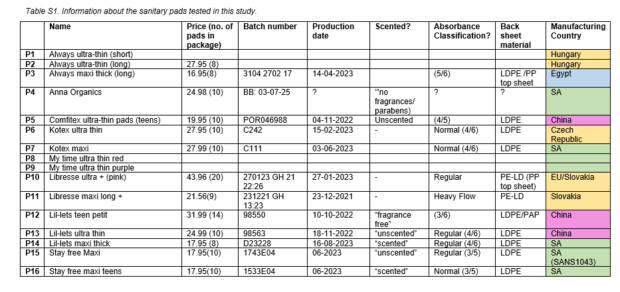
Blignaut et al. (2026)
“Our study highlights a concerning reality regarding the safety of menstrual products,” said Prof Visser, Head of the Department of Chemistry at the UFS.
“Many sanitary pads and liners contain hormone-disrupting chemicals, even when they are marketed as being ‘free from harmful chemicals’.”
The findings further noted that these substances may not always be added intentionally, as they may move into products from plastics, adhesives, and manufacturing processes.
“The heat-pressing process can cause these chemicals to move into the top layer that touches your skin,” Prof Visser explained.
We asked a specialist to explain the risks of endocrine-disrupting chemicals
Endocrine‑disrupting chemicals (EDCs) are substances that can interfere with the endocrine system, which influences hormonal health,
“Hormones operate at extraordinarily low concentrations, and they coordinate systems that matter for reproduction, thyroid function, metabolism, brain function, inflammation, and the pace of biological ageing—so even “small nudges” in signaling can matter, especially across sensitive life stages,” explains Dr. Craige Golding, an integrative medicine and anti-aging specialist.
Now, while the UFS researchers acknowledge that the levels detected in a single menstrual product may be small, they state their real concern is about the repeated exposure over time, which is something that Dr. Golding also has concerns about.
“Menstrual products matter for a simple reason: they are used repeatedly over decades, and some are in contact with vulvar or vaginal tissue, which is biologically designed for absorption in medical contexts.”
What are the dangers of EDCs?
According to Dr. Golding, EDCs like phthalates, bisphenols, and parabens can mimic or block natural hormones, especially estrogen They can also interfere with hormone signaling, which can increase the risk for many hormonal disorders and conditions.
He adds that low‑dose, long‑term exposures are rarely about dramatic mechanisms and more about subtle shifts across the body that can be quite consequential, especially for systems that are hormone-dependent.
For instance, one 2024 review found a link between EDC exposure and reproductive aging and early menopause.
An impact on metabolic health and the risk of obesity over time
Regarding metabolic health, Dr. Golding explains that the impact of EDCs on your metabolism is one of the clearest pieces of evidence of their long-term exposure. In fact, previous studies have linked EDCs, particularly phthalates and BPA, to higher risks for obesity. According to Golding, clinically, metabolic effects matter because they can amplify other hormonal issues.
What’s more, hormonal disruption can influence inflammation, oxidative stress, and mitochondrial function, which, over time, may contribute to accelerated biological aging. However, Dr. Golding points out that this is still an evolving field.
“These effects are usually not dramatic or immediate. They’re gradual and often influenced by genetics, diet, stress levels, and other environmental exposures. It’s rarely one product alone; it’s the total hormonal load.”
Are there symptoms of disrupted hormones?
Not exactly.
According to Golding, there’s no single symptom or lab test that definitively says, ‘this is from hormone disruptors.’ Rather, he identifies patterns of endocrine “noise”, which are typically multi‑system, subtle, and can easily be attributed to lifestyle or genetics alone.
“This is exactly why professional bodies increasingly encourage clinicians to integrate environmental health into routine care,” Golding adds.
So, while symptoms may not exist, what patterns may raise suspicion?
- Persistent PMS that seems disproportionate.
- Heavy or irregular cycles without a clear cause.
- Unexplained infertility.
- PCOS-like symptoms.
- Early puberty.
- Thyroid instability.
- Weight gain resistant to lifestyle changes
- Estrogen dominance patterns (fibroids, endometriosis, breast tenderness)
Transparency is vital
For the UFS team, the latest findings underscore the importance of transparency, especially in terms of labelling and chemical regulation.
“This study serves as a wake-up call that current regulations and ‘clean’ labels in South Africa may not be providing the protection consumers expect.” – Prof Visser
Speaking on the gaps in chemical regulation in South Africa, Prof. Visser adds that while the South African Bureau of Standards (SABS) does have the SANS 1043 test, it only tests for microbiology, absorbency, etc.
“According to our knowledge, there are no standards regarding the chemicals we observed.”
Furthermore, as manufacturers are generally not required to disclose the full chemical composition of menstrual products, Visser adds that he and his team believe that manufacturers should disclose all chemicals in their products, even if they fall below daily limits.
Improving menstrual health
The latest findings form part of a broader UFS initiative addressing menstrual health and access, which is why the team is currently working on innovations to improve menstrual health.
“Our team is in the process of developing a reusable sanitary pad with superpowers – antimicrobial properties,” reveals Visser. In the meantime, Visser suggests that menstruating consumers opt for products certified under the OEKO-TEX Standard 100, or to consider reusable alternatives.
What should women do?
How safe are eco-friendly menstrual products, especially since previous studies suggest that they contain harmful chemicals?
“I would still recommend eco‑friendly options-but with an important adjustment: recommend the right products for the right person, rather than trusting the label,” explains Golding. Referencing the recently published South African study, he adds how it explicitly notes that some brands advertise as being free of harmful chemicals, yet EDCs were still detected across products tested.
“In other words, ‘eco’ and ‘chemical‑free’ marketing can be aspirational rather than analytically verified,” says Golding, before adding that while eco-friendly doesn’t mean perfect, it can mean better. With that, he would still recommend them, selectively, but using a hierarchy:
- Lowest plausible chemical burden: Dr. Golding advises you to opt for fragrance‑free, dye‑free products with minimal additives, as “the best leachables work suggests that fragrances and certain plastic additives are among the chemicals that can plausibly migrate under use conditions.”
- Reusable: Menstrual cups/discs can be excellent for many people as they reduce contact with adhesives, absorbent fibres, and fragranced components. However, there’s a catch. Golding points out that quality, material transparency, and correct hygiene matter. (Golding shares that the U.S. Food and Drug Administration (FDA)’s updated guidance explicitly treats cups as devices needing material/additive accounting and biocompatibility considerations.)
- Period underwear: Opt for brands with credible, current PFAS‑free claims supported by testing or reputable certification, and avoid products marketed as “stain‑resistant” or “waterproof” without disclosure.
Avoiding endocrine-disrupting chemicals
While this article does delve into the link between menstrual products and endocrine-disrupting chemicals, it should be noted that those products aren’t their only source.
“They show up in plastics, food contact materials, personal care products (often via “fragrance” chemicals), and many everyday consumer goods,” says Golding, adding that many are considered non‑persistent (they clear from the body within hours to a couple of days), yet exposure can be “pseudo‑persistent” because contact is frequent and ongoing.
As such, the best way to deal with these chemicals is to reduce the overall load, with Golding pointing out that menstrual products are only one piece, and that major wins are usually in daily food and personal care routines:
- Bisphenols: Reduce contact between food/drink and plastic/epoxy linings where you can. The Centers for Disease Control and Prevention notes BPA can enter via food/beverage contact materials, and occupational sources include thermal paper handling; swapping storage for glass/steel, and limiting heating of food in plastic are practical steps.
- Phthalates: Reduce highly fragranced personal care products and highly processed/packaged foods where feasible.
- Parabens: Prioritise paraben‑reduction in leave‑on products (lotions, creams) if you are trying to lower body burden.
This is a global problem
These chemicals are linked to endocrine disruption, reproductive issues like infertility and endometriosis, and potential cancer risks.
Key Findings on Toxicity
- Heavy Metals: A study found all 30 tested tampons contained lead. Another analysis detected 16 different metals in various tampons, raising concerns about absorption through the vaginal mucosa.
- PFAS and Plastics: “Forever chemicals” (PFAS) were found in 48% of tested pads, 22% of tampons, and 65% of period underwear, according to recent tests.
- Volatile Organic Compounds (VOCs): These, used in fragrances or adhesives, can be absorbed during use.
- Hormone Disruptors: Studies, including research from the University of the Free State, found that 16 brands of sanitary pads and liners contained at least two types of endocrine-disrupting chemicals.
- Vaginal Health: The presence of these chemicals is linked to irritation, bacterial infections, yeast infections, and potentially pelvic inflammatory disease.
Regulatory and Safety Concerns
Globally, menstrual products are not always subject to rigorous, mandatory testing for toxic chemicals.
“Natural” or “organic” products may still contain undisclosed substances or use vague marketing terms. This is misleading to the customer.
The vaginal area is highly permeable, making it a direct route for chemical absorption into the body.
Tips for Reducing Exposure
- Avoid Fragrances: Choose unscented pads, tampons, and liners to reduce VOC exposure.
- Check Certifications: Look for products with certifications from reputable organizations like GOTS (Global Organic Textile Standard) or Oeko-Tex.
- Read Labels Carefully: Prioritize brands that list all ingredients, avoiding those with vague descriptions.
- Consider Alternatives: Consider using menstrual cups or products with high-quality, organic materials, but still research the brand.
Our eco-friendly menstrual choices
For consumers concerned about their menstrual product choices, Longevity has compiled the following list of the best eco-friendly products that can ensure improved menstrual hygiene and health.
1. Petallite Organic Sanitary Pads
These pads are hypoallergenic, unscented, and free from dyes, perfume, chlorine, dioxin, and rayon are perfect for heavy flows, as well as for vegans & strict vegetarians. Grab them here.
2. Gentle Day Regular Pads – Organic & Hypoallergenic
Crafted from 100% eco-certified materials free from fragrance, toxins, and chlorine bleach, these hypoallergenic pads feature a FAR-IR anion strip that provides superior protection from odour, bacteria, and skin irritation. Grab them here.
3. FtN Slim Goddess Menstrual Cup – Medium
The Hypo-allergenic & biocompatible Faithful to Nature Goddess Cup is a safe, comfortable, and eco-friendly product that can be used for up to 5 years. Latex-free and BPA-free, the soft medical-grade silicone is kind to your body. Grab it here.
4. Natracare Organic Cotton Regular Tampons
As they’re made from only certified organic 100% cotton, Natracare tampons are the only fully certified organic cotton tampons available in the world today. They are non-chlorine bleached and are free of synthetic materials, such as rayon, or chemical additives such as binders or surfactants. Grab them here.
5. Eco Boom Daily Panty Liners
Plastic-free, these pantyliners are made with 100% breathable bamboo viscose, offering a soft, comfortable, yet super absorbent wear free of harmful, skin-irritating chemicals. Grab it here.
6. Hannahpad Pantyliner Non-Slip 2 pack
A reusable pantyliner, this product has a pure organic cotton cover, which is gentle on delicate skin and will keep you feeling dry and comfortable. It contains no bleach, dyes, glues, or formaldehyde, and can be reused for years. Grab it here.
7. Bodhi B Boyshort – Heavy Absorbency
Perfect for a heavy flow, Bodhi B Boyshort. Designed for heavy flow, you can reduce your carbon footprint and period care costs with this boyshort period underwear. Grab it here.
8. Woman-Kind Menstrual Sponges Pack of 2 (Medium & Large)
A Mediterranean Sea sponge, these products are 100% natural, biodegradable, and sustainably harvested. Not only are they free of harsh chemicals, but they can be reused over several months. Grab them here.
Editor’s note: While this article quotes specifically the latest study conducted in South Africa, this is a worrying global problem. Indeed, most of the sanitary products reviewed by UFS are available around the world and marketed by large corporations that sell these listed products in many countries.
References
Blignaut, J., Kemp, G., Erasmus, E., Visser, H. G., & Schutte-Smith, M. (2026). The presence of endocrine disrupting chemicals in sanitary pads: A study done in South Africa. Science of The Total Environment, 1018, 181510. https://doi.org/10.1016/j.scitotenv.2026.181510
CDC (2025). Occupational Exposure to Bisphenol A (BPA) in U.S. Manufacturing Companies. [online] NIOSH Science Blogs. Available at: https://www.cdc.gov/niosh/blogs/2017/bpa.html
Inman, Z., & Flaws, J. A. (2024). Endocrine Disrupting Chemicals, Reproductive Aging, and Menopause: A Review. Reproduction (Cambridge, England), 168(5), e240113. https://doi.org/10.1530/REP-24-0113
Wicks, A., Brady, S., Whitehead, H.D., Hedman, T., Zachritz, A., Venier, M. and Peaslee, G.F. (2025). Per- and Polyfluoroalkyl Substances in Reusable Feminine Hygiene Products. Environmental Science & Technology Letters. doi:https://doi.org/10.1021/acs.estlett.5c00553
Xiao, T., Huang, Z., Zheng, C., Quach, B., Zhu, Y., Li, F., Liang, W., Baker, J., Reichetzeder, C., Hocher, B., & Yang, Y. (2024). Associations of bisphenol A exposure with metabolic syndrome and its components: A systematic review and meta-analysis. Obesity reviews : an official journal of the International Association for the Study of Obesity, 25(6), e13738. https://doi.org/10.1111/obr.13738
Xu, X., Wu, H., Terry, P. D., Zhao, L., & Chen, J. (2021). Impact of Paraben Exposure on Adiposity-Related Measures: An Updated Literature Review of Population-Based Studies. International Journal of Environmental Research and Public Health, 19(23), 16268. https://doi.org/10.3390/ijerph192316268
First study to measure toxic metals in tampons shows arsenic and lead, among other contaminants

![women [longevity live]](https://longevitylive.com/wp-content/uploads/2020/01/photo-of-women-walking-down-the-street-1116984-100x100.jpg)