

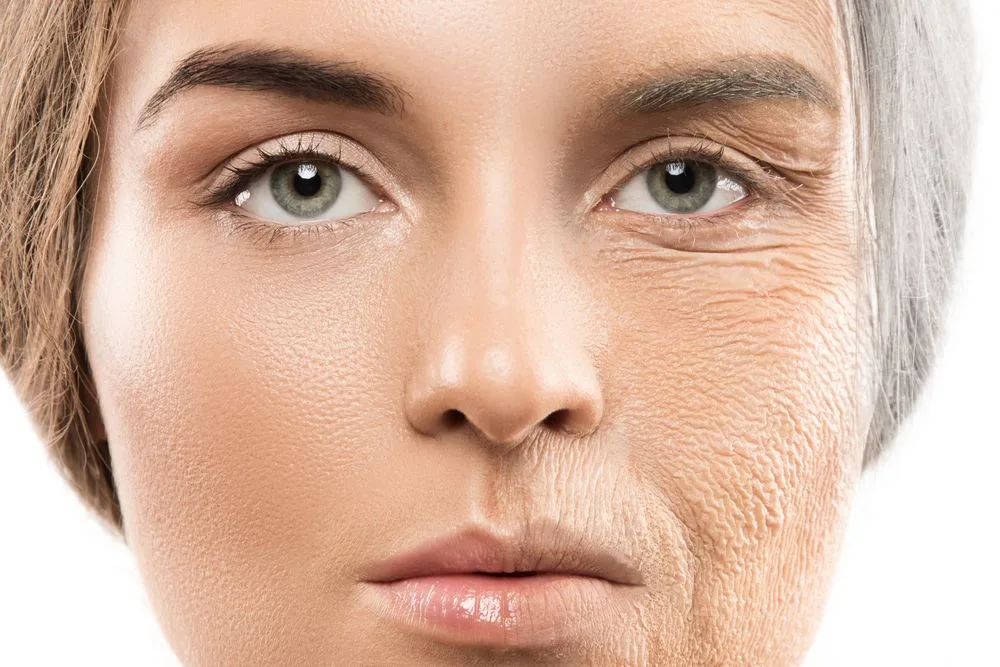
When most people think of skin aging, they picture sun damage (photoaging), the passing years (intrinsic aging), or perhaps the occasional bad habit. But after decades of working with skin, I’ve learned that there’s a much quieter, far more insidious culprit at play: something we now call inflammaging.
What is inflammaging?
Inflammaging is chronic, low-grade inflammation that slowly chips away at your skin’s vitality from within. Aging isn’t just about counting birthdays; it’s shaped by the cumulative effects of stress: emotional, environmental, and biochemical.
Inflammaging is the invisible inflammation triggered by everyday stressors such as pollution, UV exposure, poor sleep, burnout, emotional stress, and even certain foods. Acute inflammation, like when you graze your knee,
is part of your body’s healing process. Chronic micro-inflammation, however, quietly wears the skin down over time. It breaks down collagen, weakens your skin barrier, and slows your skin’s ability to regenerate.
I like to think of your skin as the canvas of your life. When stress is constant, that canvas starts
to lose its glow, showing dullness, fatigue, and sensitivity, and then it starts cracking, and fine lines develop long before their time.
The Brain-Skin Connection
By exploring how the embryo develops, we’ve discovered that the cell layer that’s responsible for the development of the skin is also the area where the cells develop into the brain and nervous system.
The cells that give skin its variety of human skin color, the melanocytes, develop in that special area and then migrate to the skin. They’re like nerve cells, and as the embryo matures, the nerves elongate and establish a very firm connection between the brain and the skin. Not only is there a physical connection, but a chemical synergy and interaction develops.
Your skin is more than a covering
That’s because your skin is much more than a covering; it’s connected directly to your brain through the hypothalamic-pituitary-adrenal (HPA) axis, the body’s stress-response system. When that system is over-activated, it produces excess cortisol, the “stress hormone” that breaks down collagen, slows repair, and keeps the skin locked in a cycle of inflammation.
I often see people with solid skincare routines whose skin just isn’t responding as it should. The problem usually isn’t the products; it’s that the skin is exhausted on a cellular level.
If we want skin to stay healthier for longer, we can’t just treat symptoms. We need to restore its function and resilience from within. This is where neurocosmetics are so exciting. These are ingredients that actively help to interrupt the brain-skin-stress cycle, encouraging the skin to adapt and recover.
I’m particularly proud of our work with Seriénce Night Serum, which was created specifically for this. We have a considerable amount of evidence that Seriénce Night Serum is very effective in dealing with inflammaging.
Is Your Skin Under Stress?
Some tell-tale signs include:
- A lack of radiance;
- Skin that feels depleted, not just dry;
- Early fine lines and wrinkles;
- Sensitivity that’s hard to settle; and
- Pigmentation that hangs around after
These aren’t just cosmetic issues; they’re signals that your skin is tired beneath the surface. As I often say, inflammaging is the whisper before the scream.
End note
Skincare, for me, has never been just about looking younger; it’s about helping skin to stay biologically healthy and adaptive for as long as possible.
Key ingredients are scientifically proven in independent clinical studies and are included in the Seriénce Night Serum at clinically eflective concentrations.
Who is the author?

Dr Des Fernandes, founder of Environ Skincare
Dr. Des Fernandes is the founder and scientific director of Environ Skin Care.
Prof. Des has pioneered the use of vitamin A in cosmetic products. “The results are now similar to those achieved using retinoic acid for a more convincing rejuvenation of the skin,” he says.
He has also patented the Environ DF iontophoresis and low-frequency sonophoresis machine. “We can now achieve results comparable to having fractionated laser treatments,” he says. “These treatments also enhance the effects of Botox injections and reduce fatty deposits.”
GRAB A COPY OF OUR LATEST LONGEVITY
 This article, and many others, can be found in our latest “Back to the Earth” edition.
From expert insights with Dr. Zach Bush, Dr. Ash Kapoor, Oscar Chalupsky, Dr. Ela Manga, Dr. Maureen Allem, Dr. Anushka Reddy, Dr. Des Fernandes, Dr. Craige Golding, and many more, this issue explores everything from food, clean beauty, sustainable living, fashion, travel, and other mindful choices.
While available nationally in Southern Africa at your nearest Woolworths, Exclusive Books, and selectively at Superspar, Pick’n Pay, Airport lounges, and your local garage shop, you can also buy a digital copy at Zinio.com.

![women [longevity live]](https://longevitylive.com/wp-content/uploads/2020/01/photo-of-women-walking-down-the-street-1116984-100x100.jpg)