

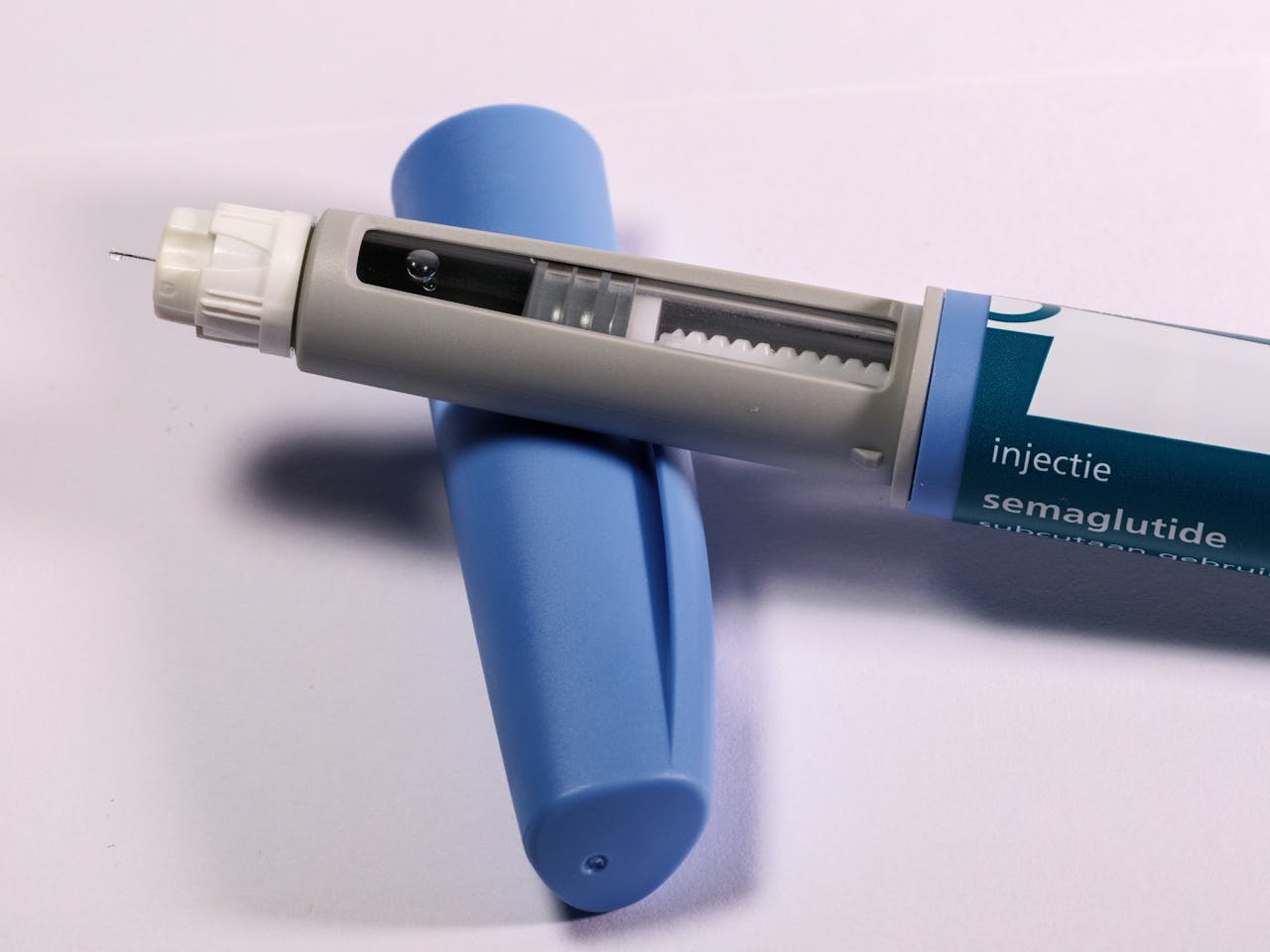
Over the past few years, Ozempic has officially become part of the global lexicon, often used interchangeably to refer to a group of wildly popular weight-loss medications known as GLP-1s. Now, while widely known for their weight loss effects, researchers have begun delving into GLP-1 drugs’ other potential benefits, and one recent study has suggested that they may hold serious potential for treating addictions.
GLP-1 and Addiction Noise
Dr. Al-Aly is a physician-scientist and senior clinical epidemiologist at Washington University in St. Louis, who directs the Clinical Epidemiology Center and currently serves as the Chief of Research and Development Service at the VA St. Louis Health Care System.
Speaking about his work, Dr. Al-Aly shared an anecdote of a patient, a veteran, who had tried to quit smoking for over a decade. The patient later revealed that after he started a GLP-1 drug for his diabetes, he lost interest in cigarettes, all without the use of nicotine patches or any effort. What’s more, a different patient shared that after the use of a GLP-1 drug for weight loss, alcohol had lost its pull – after years of failed attempts to quit.
While neither patient started taking GLP-1 drugs to curb their addictions, Dr. Al-Aly could not ignore the underlying link between their separate experiences.
Just as GLP-1 drugs help people lose weight by working in the gut and helping reduce ‘food noise’, Dr. Al-Aly’s patients noted a reduction in ‘substance noise’. Because many addictions have no approved treatment, Dr. Al-Aly sought out to test whether these GLP-1 drugs could curb addiction cravings and become effective addiction treatments.
The Study
Dr. Al-Aly and his team analyzed data on more than 600,000 patients with Type 2 diabetes from the U.S. Department of Veterans Affairs who were treated with either GLP-1 medications or SGLT2 inhibitors, which work by removing excess sugar from the kidneys.
Using this data, the team then compared people who started GLP-1 drugs to people who did not, adjusting for differences in health history, demographics, and other factors, and followed both groups for three years. They also asked two important questions;
- For people already struggling with addiction, did the drugs reduce overdoses, drug-related hospitalizations, and deaths?
- For people with no prior substance use disorder, did GLP-1 drugs reduce their risk of developing one across all major addictive substances: alcohol, opioids, cocaine, cannabis, and nicotine?
GLP-1 and Addiction Treatment
“The biggest revelation for me is that [these GLP-1 drugs] are working across different substances…There is no medicine, or no precedent in our armamentarium that actually has this property of working across addictive substances.” – Dr. Al-Aly
Per the findings, published in The BMJ, people who were taking GLP-1 had a 14% to 25% reduced risk of developing an addiction compared to people prescribed an SGLT2 inhibitor, and the reduction was found to be greatest in terms of developing a dependence on opioids, which is great news as we’re in the midst of a growing opioid addiction epidemic.
Regarding people with no prior substance use disorder, GLP-1 worked to reduce their risk of developing alcohol use disorder by 18%, their risk of opioid use disorder by 25%, and their risk of cocaine and nicotine dependence by approximately 20%.
Amongst those struggling with addiction, there were 39% fewer overdoses, 26% fewer drug-related hospitalizations, 25% fewer suicide attempts, and 50% fewer deaths from substance use among those taking GLP-1 drugs.
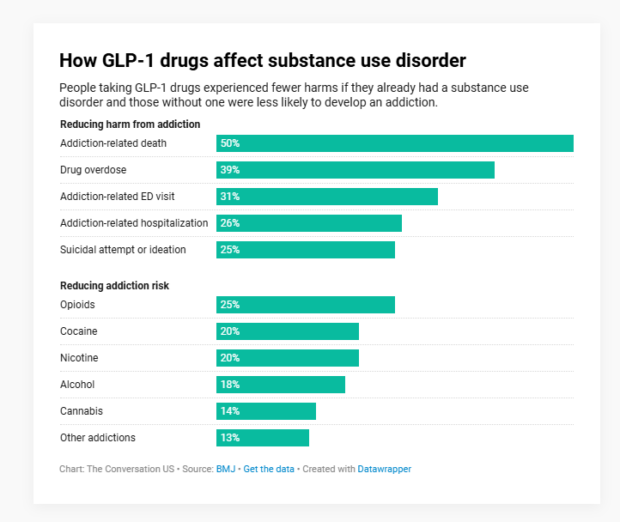
Chart: The Conversation US. Source: BMJ. Created with Datawrapper
“Here is a trial with 600,000 people studying not just opioids or nicotine or alcohol, but all of them. So, it’s unlikely to be a coincidence or chance finding,” says Al-Aly, adding that their findings align with a growing body of evidence.
For instance, a 2024 Swedish study found that those with alcohol use disorder who were taking GLP-1 drugs had a 36% lower risk of alcohol-related hospitalizations, and a separate study found a link between semaglutide and a 50%-56% reduced risk for both the incidence and recurrence of alcohol use disorder over a 12-month follow-up period.
Could GLPs be a game changer for addiction?
With substance-use-related illnesses and deaths continuing to plague the nation, identifying a single medication that could treat multiple substance use disorders would be a game-changer.
Despite the findings, the study has its limitations. For one, the data used was overwhelmingly male and older. Also, how would these drugs affect addiction once people stop taking them, as many who stop taking GLP-1 drugs for treating obesity typically regain the weight they lost, so would this happen with addiction?
“I worry about what will happen, since if [these drugs] put the lid on craving in the mesolimbic system [of the brain], then all of a sudden people stop taking them, and the craving then comes back with a vengeance,” says Al-Aly, adding that more research is needed to understand and appreciate the uncertainties.
“I’m excited by these results, but as a scientist, I would not advise prescribing [GLP-1s] for the sole indication of addiction at this point, pending more studies and understanding, and more resolution of uncertainties.”
References
Al-Aly, Z. (2026). GLP-1 drugs may fight addiction across every major substance, according to a study of 600,000 people. [online] doi:https://doi.org/10.64628/aai.h3med45fx.
Lähteenvuo, MS., Tiihonen, J., Solismaa, A., et al. (2024). Repurposing Semaglutide and Liraglutide for Alcohol Use Disorder. JAMA Psychiatry. doi:https://doi.org/10.1001/jamapsychiatry.2024.3599
Qeadan, F. (2026). Metabolic medicines and addiction: what GLP-1 receptor agonists might add to substance use care. BMJ, 392, p.s325. doi:https://doi.org/10.1136/bmj.s325.
Wang, W., Volkow, N. D., Berger, N. A., Davis, P. B., Kaelber, D. C., & Xu, R. (2024). Associations of semaglutide with incidence and recurrence of alcohol use disorder in real-world population. Nature Communications, 15(1), 4548. https://doi.org/10.1038/s41467-024-48780-6

![women [longevity live]](https://longevitylive.com/wp-content/uploads/2020/01/photo-of-women-walking-down-the-street-1116984-100x100.jpg)