

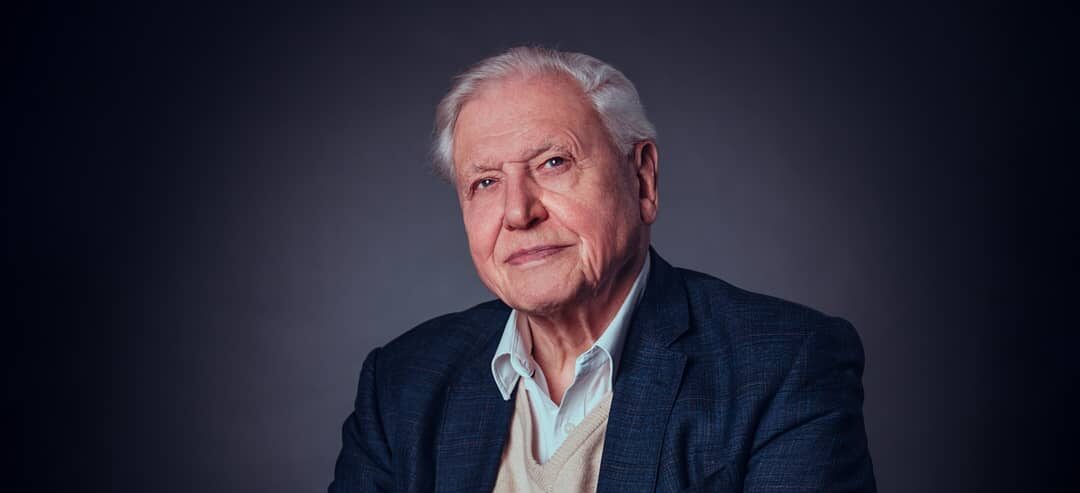
What do Beyoncé and Sir David Attenborough have in common? They both have insects named after them. Now, while Beyonce’s namesake is mostly due to her memorable figure, Sir David Attenborough’s honor comes from the London Natural History Museum, who have named a new species of wasp as Attenboroughnculus tau. Not only does this recognize Attenborough’s work, but it’s also the perfect gift for his 100th birthday, showing how the now centenarian is still busy advocating for nature and all its beauty, with no chance of slowing down.
Sir David Attenborough Turns 100: Blue Zone Habits That Helped
According to research from the Chobanian & Avedisian School of Medicine, which focuses on centenarians, the number of people living past 100 has nearly doubled. While there are studies examining the factors behind the numbers, Attenborough has credited his healthy aging to ‘luck’. Speaking to The Guardian before his 90th birthday, he shared,
“The only conclusion you can have is that, by God, you are lucky. When you think, I have relatives and friends who are 90, and they can’t remember what day it is, and they can’t walk – this is not Christian virtue, just luck.”
Now luck alone can’t explain it, especially since his father, Frederick Attenborough, lived to 85. Genetics definitely plays a role, but so do Attenborough’s lifestyle habits, many of which overlap with the habits of people living in Blue Zones – five regions around the world notorious for being virtually free of disease and having a population that lives exceptionally long.
With that, if you’re hoping to live to 100 so that you can continue to enjoy Sir David Attenborough’s documentaries, then here are a few habits to pick up.
1. He skips red meat
Unsurprisingly for someone notorious for his conservationism, Attenborough shared in 2017 that he had not eaten red meat in months. He further added in 2020 in the Netflix documentary, A Life On Our Planet, how beneficial such a decision is for the planet’s well-being.
“The planet can’t support billions of meat-eaters. If we all ate only plants, we’d need only half the land we use at the moment.”
Not only is cutting back red meat great for the planet, but doing so has also been found to be extremely beneficial for one’s longevity, with benefits that include;
- Reduced cholesterol
- Improved heart health
- Lowered inflammation
- Reduced risk of chronic conditions, such as cancer and diabetes
- Better gut microbiome
As for the rest of his diet, it can best be described as flexitarian, as he admits to eating cheese and fish, the latter of which is rich in omega-3 fatty acids, which have been proven to be beneficial for brain and heart health.
2. He eats small meals
Hara Hachi Bu is a dietary rule followed by Okinawans, inhabitants of the Blue Zone, Okinawa. The rule suggests stopping eating when someone is about 80% full. For Attenborough, smaller meals don’t just prevent overeating, but they’re also a great way to prevent waste.
“I’ve never really been one for eating enormous meals, and I’m not particularly a gourmet either, so I can’t pretend that I’m feeling deprived in any way or that it’s cost me all that much,” he’s said, adding that since every single mouthful of food we take is dependent on a healthy planet, the one thing we can all do is to stop waste.
What’s more, eating smaller meals has been found to stabilize blood sugar, improve digestion, and even increase productivity.
3. He spends time in nature
Outside of the late Jane Goodall, it’s hard to think of anyone who has spent more time in nature than Sir David Attenborough.
“One of the simplest things that you should do when you get the chance is to stop, sit down, don’t move, keep quiet, and wait 10 minutes. I’d be surprised if something pretty interesting didn’t happen.” – Sir David Attenborough.
Immersing yourself in nature, free of devices, can help to reduce stress, improve your mental health, improve sleep quality, and even boost your immune system, with one study revealing that forest walking increases (sIgA) levels, an antibody that acts as a first line of defense against infections.
4. He loves animals
Whether he’s petting a llama or running around with gorillas, Attenborough is the world’s biggest animal lover, and that may be why he seems so healthy and carefree.
Now, while you don’t need to travel to the Democratic Republic of Congo to walk with gorillas, interacting with pets has been found to reduce stress levels, lower blood pressure, and even prevent early death. In fact, the American Heart Association revealed that dog owners tend to live longer, with a 24% lower risk of all-cause mortality compared to non-owners.
5. He stays active
While he’s rarely seen in the gym, Attenborough is always seen on the move, and this constant physical activity is why he seems so fit.
You don’t need a gym membership to reap the benefits of exercise, as something as simple as taking a walk around your neighborhood or exploring a hiking trail can reap the same benefits.
6. He has a purpose
For residents of Okinawa, Japan, the word ‘ikigai’ refers to one’s purpose – the reason that they get out of bed in the morning.
Attenborough began working at the BBC in 1952, and decades later, he doesn’t seem to have any plans to retire, as he remains passionate about his work and finds meaning in it, continuing to educate the public about planet Earth and how we can better protect it. With studies
With research highlighting how having a strong sense of purpose can improve longevity, including physical, cognitive, and emotional benefits, it’s not too late to explore what you’re destined to do.
By zeroing in on your strengths, identifying the things you care about, and reflecting on what matters, you too can find meaning in your work and life.
Want to know more?
Sir David Attenborough isn’t the only one who’s recently joined the centenarian club, as Dick Van Dyke officially became a centenarian on December 13. With that, here’s Dick Van Dyke’s 9-Step Guide to Turning 100, all of which includes his incredible charisma.
References
American Heart Association (2019). Do dog owners live longer? [online] www.heart.org. Available at: https://www.heart.org/en/healthy-living/healthy-bond-for-life-pets/do-dog-owners-live-longer
National History Museum. (2026). New species named after David Attenborough to celebrate his hundredth birthday | Natural History Museum. https://www.nhm.ac.uk/discover/news/2026/may/new-species-named-after-david-attenborough-to-celebrate-his-100-birthday.html
Ochiai, H., Inoue, S., Masuda, G., Amagasa, S., et al. (2025). Randomized controlled trial on the efficacy of forest walking compared to urban walking in enhancing mucosal immunity. Scientific Reports, 15(1), 3272. https://doi.org/10.1038/s41598-025-87704-2
Plunkett, J. (2016). Sir David Attenborough warns against playing ‘fast and loose’ with BBC. [online] The Guardian. https://www.theguardian.com/tv-and-radio/2016/may/03/david-attenborough-warns-against-playing-fast-and-loose-bbc
Spellman, C. (host) 2021, ‘Exploring our natural world – with Sir David Attenborough’, Call Of The Wild, podcast audio, 17 February. Available at: Apple Podcasts

![women [longevity live]](https://longevitylive.com/wp-content/uploads/2020/01/photo-of-women-walking-down-the-street-1116984-100x100.jpg)