
Would you love to make pasta from scratch and infuse it with herbs from a well-tended garden? Is it your secret dream to quit your job and move far away from the hustle and bustle of city life?
In this day and age, it seems you’re not alone. With society overrun by anxiety, stress, sky-high living costs, and worry over the amount of hours of screentime our children are getting every day, an emerging trend is pulling us back to the earth, working and creating with our hands again. The result? A greater sense of calm.
Since the COVID-19 pandemic, more and more stories are emerging of people quitting their high-paying corporate jobs to move to remote locations and live a life that many see as more fulfilling. This trend is also driving greater levels of agritourism, particularly towards farm stays and other rural options that enable us to rediscover ancient practices, such as beekeeping, pottery, and regenerative agriculture.
The re-emergence of the tradwife
Let’s say you make your own kombucha, you’re a potter, or you’ve learned to make quilted blankets.
In today’s world, you might be labeled a tradwife: a woman embracing traditional domestic roles such as homemaking, childcare, cooking, and supporting her husband. Most self-proclaimed tradwives are proud of their choice of lifestyle, and often encourage other women to embrace similar values.
According to The Economist, the concept has picked up steam online too, particularly on TikTok, where it has over 600 million views.
“The definition of a tradwife is not merely someone who stays at home,” said Monica Hesse, a columnist for The Washington Post. “But [someone] who romanticizes it in a retro, nostalgic way, where we’re looking back not only to the way things worked in the ‘50s, but the values that families had in the ‘50s.”
Women such as Nara Smith, Estee Williams, Ivy van Dusen, and Tieghan Gerard are the poster children for this lifestyle. In many ways, they stand out like sore thumbs in a world where the greater majority of women are active in the workforce. In the US, it’s estimated that over 56% of women work outside the home, while over 54% of all US households sport two incomes. In 1955, this figure was 26%.
“My brand is embracing motherhood and enjoying motherhood,” said Van Dusen. “A lot of people, unfortunately, have this negative view of the way people used to live,” she said. “I was really close with both my grandmothers and even my great-grandmother, and they were just the coolest women. When I hear homemakers, when I hear traditional women, I think of really amazing women.”
And the queen of it all?
ballerinafarm/instagram
According to Internet lore, the title of top tradwife goes to Hannah Neeleman of Ballerina Farm.
She’s a true domestic goddess, shepherd, egg-collector, entrepreneur, mother of eight (between the ages of one and 12), with a ninth child on its way, not to mention a former professional ballerina who trained at Juilliard.
She lives with her husband, Daniel, and their kids on a 328 acre ranch, dairy farm, and homestead in Utah. She also competes in beauty pageants, one of which was just 10 weeks after giving birth to one of their children. The Neelemans belong to the Mormon faith, and her husband is the son of David Neeleman, who founded WestJet, JetBlue Airways, and Breeze Airways.
A business that is a lifestyle, or a lifestyle that is a business?
Yet one cannot escape the fact that Ballerina Farm has a combined 22 million followers across Instagram, TikTok, and YouTube, who watch mom make sourdough bread from scratch, or organic grass-fed butter wrapped in brown-paper packages tied up with string – literally.
Inspirational or controversial?
“I love to watch what she does, but sometimes it drives me crazy that she makes it look so easy,” said Carly Weber, an elementary-school teacher in Bloomington, Indiana, speaking to The New York Times. “I have two kids, I can barely cook one thing most days, and there she is looking perfect and teaching herself to make mozzarella.”
A widely shared article from The Times of London reads:
“Hannah Neeleman, known to her nine million followers as Ballerina Farm, milks cows, gives birth without pain relief and breastfeeds at beauty pageants. Is this an empowering new model of womanhood – or a hammer blow for feminism?”
But Hannah insists that getting married and starting a family were entirely her prioritized choice, and that she’d always known ballet would be a limited part of her life. She and Daniel both come from large families, and they’re open about realizing the shared dream of a big family.
In a video on social media, Neeleman responded to the article, calling its portrayal of her as oppressed “an attack on our family”.
“This couldn’t be further from the truth. Nothing we said in the interview implied this conclusion, which leads me to believe the angle taken was predetermined,” she continued.
A perfectly curated life
“The greatest day of my life was when Daniel and I were married 13 years ago. Together we’ve built a business from scratch, we’ve brought eight children into this world, and have our marriage all along the way. We are co-parents, co-CEOs, co-diaper changers, kitchen cleaners, and decision makers. We are one, and I love him more today than I did 13 years ago.”
Sporting ankle-length cotton dresses and cowboy boots, with minimal makeup and lightly highlighted hair usually thrown into a bun or a loose braid, to many, Hannah represents a perfectly curated, wholesome version of what being a farm wife is about.
But don’t be fooled
Admittedly, they have a lot of capital on hand due to the Neeleman family’s own success, to make any business work, even a business that doesn’t seem like a business, but an ideal lifestyle!
She and her husband have successfully developed Ballerina Farm into a thriving brand and a business that employs 50 employees at last count. It’s easy to forget that what she’s choosing to share is a very small part of her day, and that influencers such as her often have whole teams that work hard to make sure the carefully curated feed appears laid-back, relaxed, and effortless.
In addition, according to The New York Times, Hannah Neeleman and her family have part-time babysitting help, and their children are homeschooled by a teacher three days a week.
So, is this lifestyle a pipe dream for the millions of women yearning for a more peaceful and healthy existence?
Why do we keep tuning in to watch someone milk sheep?
Perhaps one of the main reasons why she’s been able to make such a success of her brand is that she’s managed to capture a sense of what the world seems to be craving at the moment: simplicity, a slower pace of living, and happy, disheveled children toddling among wildflowers in the fields, instead of being attached to their tablets.
In a way, they’re seeing a return to the life that used to be normal for most of our great-grandparents, who seemed to live much healthier and more stress-free lives. Isn’t it just a basic biological yearning to get back to our humanity?
Being able to witness that sense of purpose, just watching someone go about her day and complete simple tasks that have simple purposes – feeding, settling, nurturing, relaxing, growing, developing, building, and teaching – makes us feel that we can have some of that in our own lives.
A world ready for agritourism
Tradwives such as Hannah are also credited with leading the rebranding of farm life, particularly in terms of international agritourism, and farm-stay options are springing up around the world, offering a taste of the bounties of a simple life.
The market for agritourism is growing rapidly worldwide and is currently projected to reach $197.4 billion by 2032, according to Fortune Business Insights. This includes anything that allows individuals to engage with agricultural production, from beekeeping to allowing visitors to harvest their own produce, and grape-stomping for winemaking.
Allyson Rees, a senior strategist for trend forecasting company WGSN, believes farm stays have wide appeal amid “a desire for more authentic experiences… and feeling like your vacation has a bit more of a wellness component, and an impactful component to your mental health”, she told CNN.
In South Africa, Babylonstoren is making its mark in the area, offering workshops to tourists and visitors.
Says owner Karen Roos:
“We’d like visitors to ground themselves again. To enjoy the mountains all around as much as we do, pick their own healthy fruit and veg, play pétanque, swim in the farm dam, enjoy an hour in the spa, eat a simple, fresh dish at one of the restaurants, walk up the conical Babylonstoren hill, await sunset with a glass of wine in hand, and then slip between sheets of crisp linen and drift away… more or less.”
Workshops are primarily centered around learning how to work with your hands again, through traditional crafts such as leatherwork, blacksmithing, distilling, and soap-making.
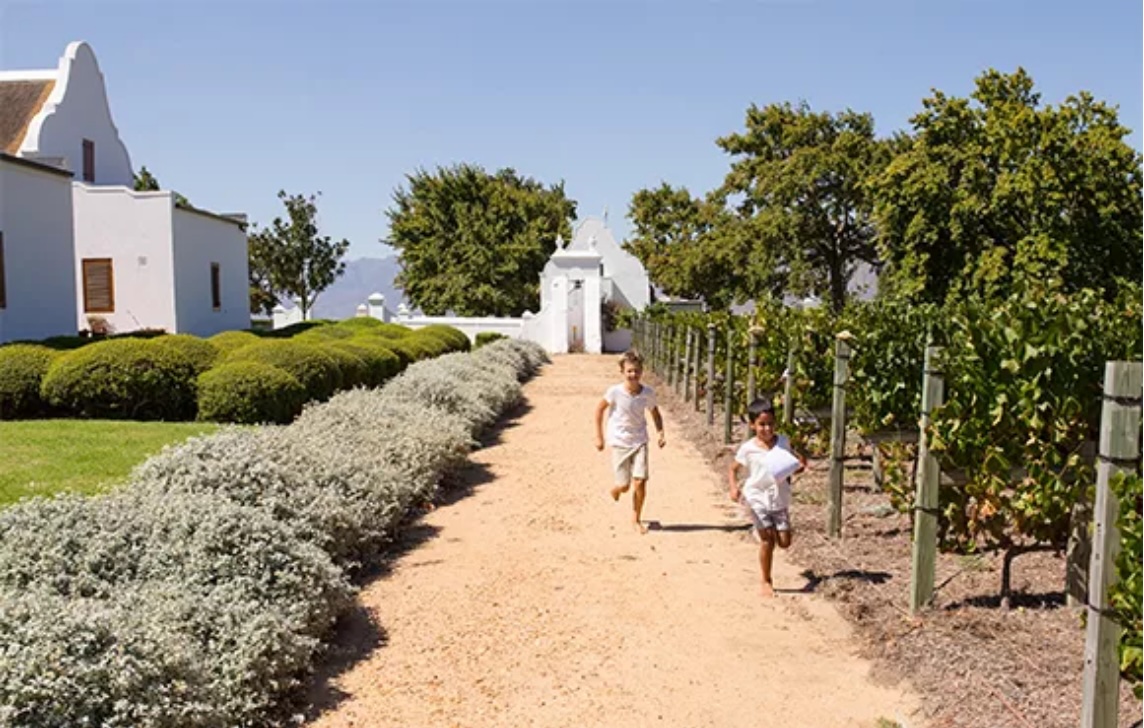
Photo credit: Bablylonstoren
“The workshops are small, with no more than 20 people per group. Various fields of interest are covered, including gardening, natural pest control, beekeeping, floral arrangement, petrology, and a host of seasonal food-preservation and preparation techniques.”
Other neighboring establishments are operating in this space too, supporting organic farming principles and regenerative agriculture. Boschendal has its own retail outlet selling its freshly grown produce on site, and Spier has developed an expansive regenerative farm, alongside its hotel, newly developed retail area and spa. (See other articles in this issue for more on this.)
A tool for dealing with depression and anxiety
In an article for Psychology Today, Dr. Susan Blall Haas explains that there’s something primal about working with your hands.
“We are made to be active, and have actively used our hands as part of our daily survival for thousands of years. With the advent of so much technology, many of us move through our days with minimal physical effort. We push a button instead of scrubbing dishes or laundry. Overall, we get far less physical activity than would be optimal for our bodies and minds. Using our hands may be key to maintaining a healthy mood, and the lack of this type of activity may contribute to feelings of irritability, apathy, and depression.”
The bottom line
When all is said and done, the yearning humans have to get back to the earth may seem retroactive. Yet, in a real sense, it’s a move towards taking control of one’s life, supporting nature and one’s health, in a world that’s pushing automization, mass production, and technocracy at an unsurpassed rate.
GRAB A COPY OF OUR LATEST LONGEVITY
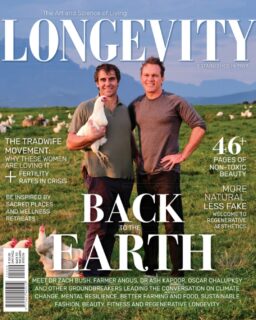 This article, and many others, can be found in our latest “Back to the Earth” edition.
From expert insights with Dr. Zach Bush, Oscar Chalupsky, Dr. Ela Manga, Dr. Maureen Allem, Dr. Anushka Reddy, Dr. Des Fernandes, Dr. Craige Golding, and many more, this issue explores everything from food, clean beauty, sustainable living, fashion, travel, and other mindful choices.
While available nationally in Southern Africa at your nearest Woolworths, Exclusive Books, and selectively at Superspar, Pick’n Pay, Airport lounges, and your local garage shop, you can also buy a digital copy at Zinio.com.

![women [longevity live]](https://longevitylive.com/wp-content/uploads/2020/01/photo-of-women-walking-down-the-street-1116984-100x100.jpg)