

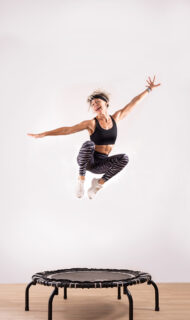
There comes a point in many women’s lives when they look in the mirror and quietly wonder what happened to the woman they used to be. The body feels unfamiliar. Energy disappears. Weight creeps on despite eating “properly.” Sleep becomes unreliable. Motivation fades. Confidence slips away almost unnoticed. For many women entering midlife and menopause, the struggle is not simply physical. It’s emotional too. Today, 62 year old, Silvia Miles is known for helping women over 50 rediscover movement through rebounding — low-impact exercise performed on a mini trampoline — but her journey did not begin in a fitness studio. It began in the same place many women find themselves now: exhausted, uncomfortable in her own body, and searching for a way back to herself. This is her story.
Why rebounding became my superpower
“I know what it feels like to lose confidence in your body,” Silvia says. “To feel bloated, tired, emotionally drained, and disconnected from who you once were. Many women think they have simply become lazy or weak. But often, they are overwhelmed, hormonally exhausted, and carrying years of stress.”
Unlike the punishing fitness culture that dominates social media, Silvia’s approach feels different. There are no extreme transformations, impossible standards, or aggressive workouts designed to leave women feeling defeated.
Instead, her philosophy is based on something surprisingly simple: consistency, safety, enjoyment, and movement that feels good.
And women are responding to it.
More Than Just Jumping
To the untrained eye, rebounding may look playful — perhaps even childlike. But behind the movement lies a powerful form of exercise that is gentle on joints while highly effective for cardiovascular fitness, balance, lymphatic circulation, coordination, and muscular endurance.
For mature women especially, this combination matters.
Many arrive carrying old injuries, aching knees, weak pelvic floors, stiffness, or fear around exercise itself. Traditional fitness classes often feel intimidating or too high-impact. Walking may no longer be enough. Running can feel impossible.
Rebounding offers another option
“A rebounder is not just for jumping on,” Silvia explains. “It can become a tool for rebuilding strength, improving mobility, restoring confidence, and reconnecting with your body again.”
Her classes focus heavily on control, rhythm, posture, balance, and musicality rather than frantic movement. Participants are encouraged to work at their own level, progressing gradually over time.
That slower, more intelligent approach is part of what has made her programs resonate so deeply with women navigating menopause and aging.
One of the reasons rebounding has gained such a loyal following among mature women is because it offers significant cardiovascular benefits without the heavy impact associated with activities like running or certain court sports. Women are able to elevate their heart rate, improve stamina, and challenge the cardiovascular system intensely, while placing far less stress on the knees, hips, ankles, and spine.
Rebounding and NASA
NASA research into trampoline exercise found that “for similar levels of heart rate and oxygen consumption,” trampolining produced greater biomechanical stimulus than running.
“Many mature women still want a proper workout,” Silvia says. “They want to feel their heart rate rise, feel energized, and feel strong again — but without paying for it afterwards with sore joints or injuries. Rebounding gives them that freedom.”
Rebounding is also widely recognized for its ability to stimulate the lymphatic system — the body’s natural drainage network. Unlike the circulatory system, which has the heart to pump blood, the lymphatic system relies heavily on movement to keep fluid flowing efficiently. According to Healthline, rebounding “may stimulate the lymphatic system” and help the body flush out waste products more effectively.
The Menopause Conversation Women Needed
Many women report feeling lighter, less inflamed, and more energized after regular rebounding sessions, making it particularly appealing during midlife when sluggish circulation, stiffness, and inflammation can become more common.
“I often tell women that rebounding makes you feel as though your body is waking up again,” Silvia says. “You feel lighter, clearer, more mobile, and more alive. For many women, that feeling is life-changing.”
One of the reasons Silvia’s message connects so strongly is because she speaks openly about realities many women feel uncomfortable discussing.
- The weight gain around the middle.
- The emotional sensitivity.
- The loss of motivation.
- The feeling of becoming invisible.
- The fear that it might simply get worse from here.
Rather than dismissing these experiences, Silvia acknowledges them directly.
“Women often blame themselves,” she says. “But menopause changes the body in ways that can feel shocking. You cannot approach a menopausal body the same way you approached your body at 25.”
Feel strong again
Instead of chasing youth, she focuses on helping women feel capable, strong, and vibrant again.
Silvia also believes that exercise alone is not enough. Mindful eating, she teaches, is equally important when it comes to long-term health, fitness, and sustainable weight loss.
Many women who begin rebounding with Silvia are not fitness enthusiasts at all. Some have not exercised consistently in years. Some arrive nervous, embarrassed, or convinced they are too unfit to start.
With consistent rebounding women they begin to trust their bodies again. Balance improves. Energy returns. Weight begins to stabilize. Women stand taller. They laugh more. They move with less fear.
Building More Than Fitness
What Silvia has created extends beyond exercise classes.
 Her work has quietly become a form of community for women who often feel overlooked by mainstream wellness culture.
For many participants, the emotional benefits become just as significant as the physical ones.
“Movement changes mood,” Silvia says. “But it also changes identity. Once a woman begins feeling physically stronger again, other parts of her life begin improving too. Confidence spills into everything.”
This is particularly important during midlife, a season where many women are simultaneously managing careers, aging parents, changing relationships, grief, hormonal shifts, and the emotional adjustment that comes with children growing older.
Exercise, Silvia believes, should help women cope with life — not become another source of pressure.
That philosophy has shaped her teaching style into one that feels deeply human.
A Different Definition of Success
In a culture obsessed with youth and perfection, Silvia measures success differently.
Success is the woman who can climb stairs without knee pain again.
The woman who stands tall and straight with a strong core.
The woman who sleeps better.
The woman who no longer dreads seeing herself in photographs.
The woman who starts feeling hopeful again.
“Women do not necessarily want perfection,” Silvia says. “They want to feel like themselves again.”
That simple statement may explain why her message resonates so powerfully with mature women.
End note
Because underneath the conversations about weight loss, fitness, and menopause lies something much deeper: the desire to come back home to oneself.
And for many women, that journey begins not with punishment, but with one small bounce at a time.
About Silvia Miles
 Silvia Miles is a rebounding instructor specializing in movement for mature women.
She focuses on strength, mobility, confidence, and sustainable fitness through low-impact rebounding workouts.

![women [longevity live]](https://longevitylive.com/wp-content/uploads/2020/01/photo-of-women-walking-down-the-street-1116984-100x100.jpg)